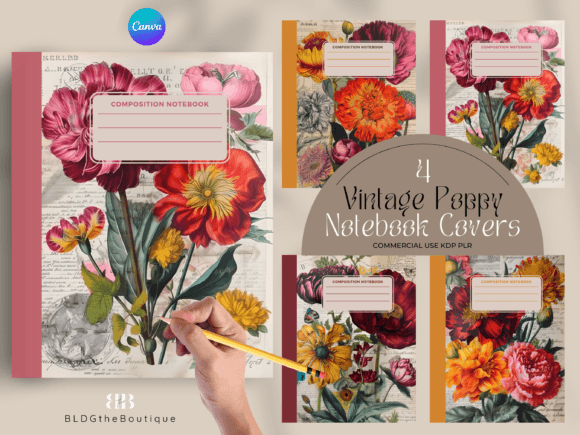
Vintage Poppy KDP Covers: A Designer's Shortcut to Charming Notebooks
If you've ever spent hours wrestling with complex design software just to create a single book cover, you know the frustration. It pulls you away from what you actually want to do: write, publish, and sell. For those of us creating low content books—journals, planners, notebooks—the cover isn't just protection; it's the entire sales pitch. It needs to catch a buyer's eye in a split second, communicate quality, and evoke a specific feeling. This is where a well-crafted set of templates like the Vintage Poppy KDP Cover Templates can completely change your workflow, turning a design hurdle into a creative sprint.
The Enduring Appeal of Vintage Aesthetics
There's a reason the vintage look never really goes out of style. It carries a sense of history, warmth, and authenticity that stark, modern designs sometimes miss. These particular templates lean into that charm with a classic poppy motif—a flower often associated with remembrance and beauty, rendered in a style that feels time-worn and elegant. The visual personality here isn't loud or trendy; it's quietly confident. Think of a well-loved botanical print or a piece of antique stationery. This aesthetic works brilliantly for a range of niches: gardeners, writers who appreciate a literary vibe, anyone creating a gratitude journal, or a planner for someone who values mindfulness and tradition. It’s a style that feels both personal and premium.
From Template to Finished Product: Practical Flexibility
The real value of a good template bundle lies in its adaptability. This set includes four distinct cover designs, each formatted for a standard 7.5"x9.25" notebook with 110 pages. But the specs are just a starting point. The Canva templates are fully editable, meaning you can shift the color palette to match a specific brand or season—swap the poppy red for a muted sage green or a dusty rose. The font on the label and spine is also customizable, allowing you to choose a typeface that aligns with your book's content. A serif font might enhance the vintage feel, while a clean sans serif could make it feel more contemporary. This level of control is crucial for maintaining a consistent brand identity across a series of notebooks. You're not just buying a static image; you're getting a design system you can own and manipulate.
For those concerned with technical specifications, the bundle provides both high-resolution JPG files (300 dpi, 12.3" x 16.4") and editable Canva links. The JPGs are ready for immediate upload to KDP's cover creator, a huge time-saver. The Canva files, however, are where the strategic advantage lies. They are formatted to the correct dimensions (15.498" x 9.5" for the full spread) and include the necessary bleed. You can resize them for different notebook formats, which is essential if you plan to offer multiple sizes. The ability to export the final design as a PDF for KDP is built into the process, ensuring a smooth submission. It's a practical toolkit designed for the realities of self-publishing on Amazon.
Streamlining Your Publishing Workflow
Let's talk about efficiency. Every hour you save on design is an hour you can spend on marketing, writing your next book, or sourcing new ideas. These templates act as a professional starting point. Instead of staring at a blank canvas, you're refining a proven, visually appealing layout. The vintage poppy theme provides immediate cohesion, which is a cornerstone of strong editorial design and packaging design. A cohesive cover series builds recognition; a customer who buys one floral journal is likely to be attracted to a matching planner or sketchbook. This is how you build a catalog, not just a single product.
It's important to note the practical details. Access requires a free Canva account, which is a low barrier to entry for most. The files are not SVG or vector, meaning they are pixel-based. For the intended use—creating book covers at standard print resolutions—this is perfectly sufficient. The 300 dpi JPGs are high quality for printing. When evaluating any design asset, considering its intended application is key. These are not meant to be infinitely scalable for a billboard, but they are perfectly engineered for the specific task of creating beautiful, sellable notebook covers for Amazon KDP.
Building a Recognizable Brand, One Cover at a Time
In the crowded marketplace of Amazon, your cover is your first and best marketing tool. A thoughtfully designed, aesthetically consistent cover does more than look good; it builds trust. It signals professionalism to potential buyers, suggesting the interior content is equally well-crafted. Using a thematic template set like this one is a strategic move. It allows you to create a visual language for your brand. The vintage typography and botanical illustration become part of your brand identity, making your products instantly recognizable in search results and on shelves.
This approach is about working smarter. You're leveraging high-quality design assets to maintain a professional standard without needing a degree in graphic design. The templates handle the heavy lifting of composition, balance, and print-ready formatting. Your job becomes the creative director's role: making strategic color and font choices that align with your niche and audience. It’s a partnership between a solid foundation and your unique creative input, resulting in products that are both beautiful to look at and simple to produce. For the entrepreneur, crafter, or publisher looking to scale their low content book business efficiently, this kind of resource isn't just a convenience—it's a competitive edge.