Charming Old European Houses Watercolor Templates for Designers
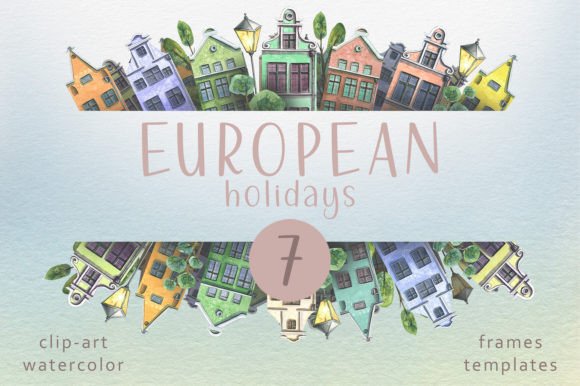
Capturing the timeless charm of European architecture in your projects just got significantly easier. The Old European Houses Watercolor Templates collection offers a distinct aesthetic that moves away from the sleek, digital perfection often seen in modern design assets. Instead, it embraces a hand-drawn, artistic quality that feels personal and authentic. Based on travels through Poland, these illustrations depict a whimsical, "gingerbread house" style featuring stone bridges, lush trees, and soft clouds. The watercolor technique provides a soft, organic texture that is difficult to replicate digitally, making these assets invaluable for designers looking to add a human touch to their work.
The appeal of this collection lies in its versatility and the specific "vibe" it creates. It is not just a random assortment of images; it is a cohesive system designed to evoke nostalgia and warmth. Whether you are a brand strategist looking for a unique visual language for a tourism client, or a hobbyist creating a scrapbook, the Old European Houses Watercolor Templates provide a solid foundation. The illustration style bridges the gap between a sophisticated editorial design element and a playful children's interior decor piece. This duality makes the set particularly useful for creative professionals who need assets that can adapt to different target audiences without losing their core identity.
Practical Applications: From Print to Textile
Understanding where these assets fit into your workflow is key to maximizing their value. The creator specifically designed the Old European Houses Watercolor Templates for a wide range of media, moving beyond simple digital use. For those in the publishing world, these illustrations serve as excellent focal points for book covers, particularly in the travel or fiction genres. Imagine using a pre-made scene as the background for a travel brochure or a souvenir postcard; the watercolor texture instantly communicates a sense of artistry and craftsmanship that standard photography often misses. It elevates a simple tourist map into a piece of art.
Beyond paper, the potential for packaging design is substantial. Small businesses, especially those in the artisan food or craft sectors, often struggle to find premium font and illustration pairings that feel genuine. These templates can be used to wrap chocolate boxes, label jams, or decorate bakery bags, reinforcing the "homemade" and "European" quality of the product. Furthermore, the collection includes elements that work beautifully for textile design. The "gingerbread" style is perfectly suited for prints on tote bags, cushion covers, or even children's clothing. Because the collection includes seamless borders and patterns, you can easily create repeating backgrounds for fabrics or digital wallpapers without worrying about visible seams or awkward tiling.
Integrating Typography and Building Hierarchy
While the visual assets are the stars of the show, the success of any design project depends on how well text integrates with imagery. When working with the Old European Houses Watercolor Templates, your typographic choices will dictate the final mood. Because the illustrations are detailed and organic, they pair exceptionally well with clean, modern typography. A sans serif font can provide a necessary contrast, ensuring that headers remain legible against the textured backgrounds. Conversely, if you are aiming for a fully traditional look, a classic serif font can complement the historical architecture depicted in the scenes.
Consider the visual hierarchy carefully. The included frames and templates are designed to draw the eye, so your text should not compete with the art. Use the "white space" or lighter areas of the watercolor compositions to place your headlines. For a more whimsical touch, such as on a wedding invitation or a boutique logo, a script font or handwritten font can work, but it must be tested for readability. The key is to let the illustrations support your message rather than overshadow it. The collection’s variety allows you to select a dense pattern for a background texture or a single house illustration as a standalone hero image, giving you control over how much visual "weight" the background holds relative to your text content.
Designing for Emotional Connection and Brand Identity
In a digital landscape saturated with generic stock imagery, using custom-feeling assets like the Old European Houses Watercolor Templates can significantly impact brand perception. These illustrations convey a sense of story and travel history. For a travel blogger or a tourism agency, this style builds immediate trust and curiosity. It suggests that the brand values culture, history, and aesthetics. This is a powerful tool for audience engagement; people are naturally drawn to imagery that looks like it was made by a human hand rather than generated by an algorithm.
When building a brand identity around these assets, consistency is vital. The collection includes various options, from isolated elements to pre-made scenes. You might use the dense seamless patterns for your website background, while the single house illustrations serve as icons or bullet points in your web design. By using the same watercolor palette and style across your social media graphics, email headers, and physical printing materials, you create a cohesive world for your audience. This consistency helps in brand recognition; clients will start to associate that specific artistic style with your business.
Maximizing the Asset Collection
To get the most out of the Old European Houses Watercolor Templates, it is helpful to view the ZIP archive as a toolkit rather than a single image. The inclusion of JPG and PNG formats offers flexibility. PNGs are essential if you need to layer the houses over different colored backgrounds or combine them with other design assets without the hassle of removing white backgrounds manually. The pre-made scenes are great for quick turnarounds, but the isolated elements allow for true customization. You can build your own compositions, perhaps placing a Polish house next to a different architectural element if the project requires it.
Finally, do not underestimate the power of the "cute" factor. While "cute" might sound simplistic, in design terms, it translates to approachability and friendliness. Whether you are designing a menu for a cafe, a flyer for a local event, or a cover for a children's book, these illustrations lower the barrier between the brand and the customer. They invite the viewer in. By thoughtfully integrating these watercolor assets with strong font pairing and clear layout principles, you can create professional, emotionally resonant designs that stand out in any market.